
How Sumble scores your accounts
Most account scoring is shallow.
You fit broad data points to paint an approximate picture of your ideal prospect — firmographic boxes ("software", "500+ employees"), some intent data ("10 open roles") and you get a score that tells you... not much.
Big company with lots of web traffic? High score.
Small company actively buying your exact category? Who knows.
Sumble's account scores are built around one question: how well does this company match what matters to you specifically?
Not "is this company important." Is this company important to you?

Step 1 - Building your Company Profile
Before you get any scores, Sumble needs to understand what you actually sell and who you sell it to. That understanding lives in your Company Profile, which captures three things:
- The technologies that matter to your company. Your own products, your competitors (both modern and legacy), and the complementary technologies that signal a potential buyer.
- If you're Fivetran, those key technologies are
fivetran,snowflake,databricks,bigquery,dbton the complementary side, andmatillion,airbyte,informatica,talendon the competitive side. If a company uses Snowflake and Informatica, that's a prospect running a modern data warehouse with a legacy ETL tool. Fivetran's sales team should know about it. - If you're Elastic, the profile looks nothing like Fivetran's. Key technologies are
elasticsearch,kibana,logstash,elk(your own stack), and competitors likesplunk,datadog,opensearch,grafana. A company running Splunk is interesting. A company running Snowflake is not.
- If you're Fivetran, those key technologies are
- The job functions you sell to. Not every role is relevant. Datadog cares about SREs, DevOps Engineers, Platform Engineers, and Cloud Engineers. Fivetran cares about Data Engineers, Analytics Engineers, and Data Architects. We track which functions are your buyers, your users, and your champions.
- The business initiatives that indicate buying moments. When a company starts hiring for cloud migration, data infrastructure migration, or microservices migration, someone has allocated budget and is picking a vendor. We detect these by scanning millions of job descriptions with a fine-tuned LLM that extracts meaning from job posts - so we know when a backend developer is being hired to move on-prem data pipelines to the cloud ("data infrastructure migration").
- Your team's search behavior on Sumble. This is the most reliable signal. When Elastic's team uses Sumble, they search for
elasticsearch(31 times in the past year),splunk(20 times),logstash(18 times),elk(17 times),kibana(17 times). They're also searching foribm-qradar— which tells us they see QRadar as a competitor worth tracking, even though it's not obvious from their marketing. When Fivetran's team uses Sumble, they search forsnowflake,matillion, anddatabricks(9 times each), andinformatica(2 times). We mine twelve months of queries to understand your real priorities - not just what someone wrote in an ICP doc six months ago. - AI fills the gaps. For new customers or niche markets where we don't yet have enough search data, we use AI to identify competitive landscapes, complementary technologies, and relevant job functions. The AI's suggestions get validated against our database — if a technology doesn't appear in real job postings, we throw it out. And its influence fades as your team's actual usage data grows. A brand new customer gets reasonable scores on day one. A customer with six months of usage gets scores grounded almost entirely in real patterns.

Step 2 - Calculating the score
Once we have your Company Profile, we score every company in our database against it. For each company, we measure three things:
How many teams use your key technologies? More teams means deeper adoption, which means a larger potential deal.
How many people work in your target job functions — and are those teams growing? A company that doubled its SRE headcount in the past year is more interesting to Datadog than one that's flat.
Are they hiring for relevant initiatives? Recent job postings that match your key projects signal active budget and decision-making. A company posting data infrastructure migration roles is a better Fivetran prospect than one that isn't.
Each dimension gets normalized and weighted. A 10-person startup and a 10,000-person enterprise are compared on the same scale:
10% of the score is overall company health — is this company growing, shrinking, or stable?
90% is fit with your specific profile — how well does this company match the technologies, roles, and initiatives that matter to your sales team?

Job function signals carry more weight than technology or project signals. Why? Because headcount growth in your buyer's department is the strongest predictor of active purchasing. A company can use Splunk passively for years. But when they start hiring more SREs and DevOps engineers, something is happening — and that's when Datadog's sales team should be paying attention.
The final score is a number per company, unique to your account. Two different Sumble customers see different scores for the same company, because the scoring reflects their fit, not some universal ranking.
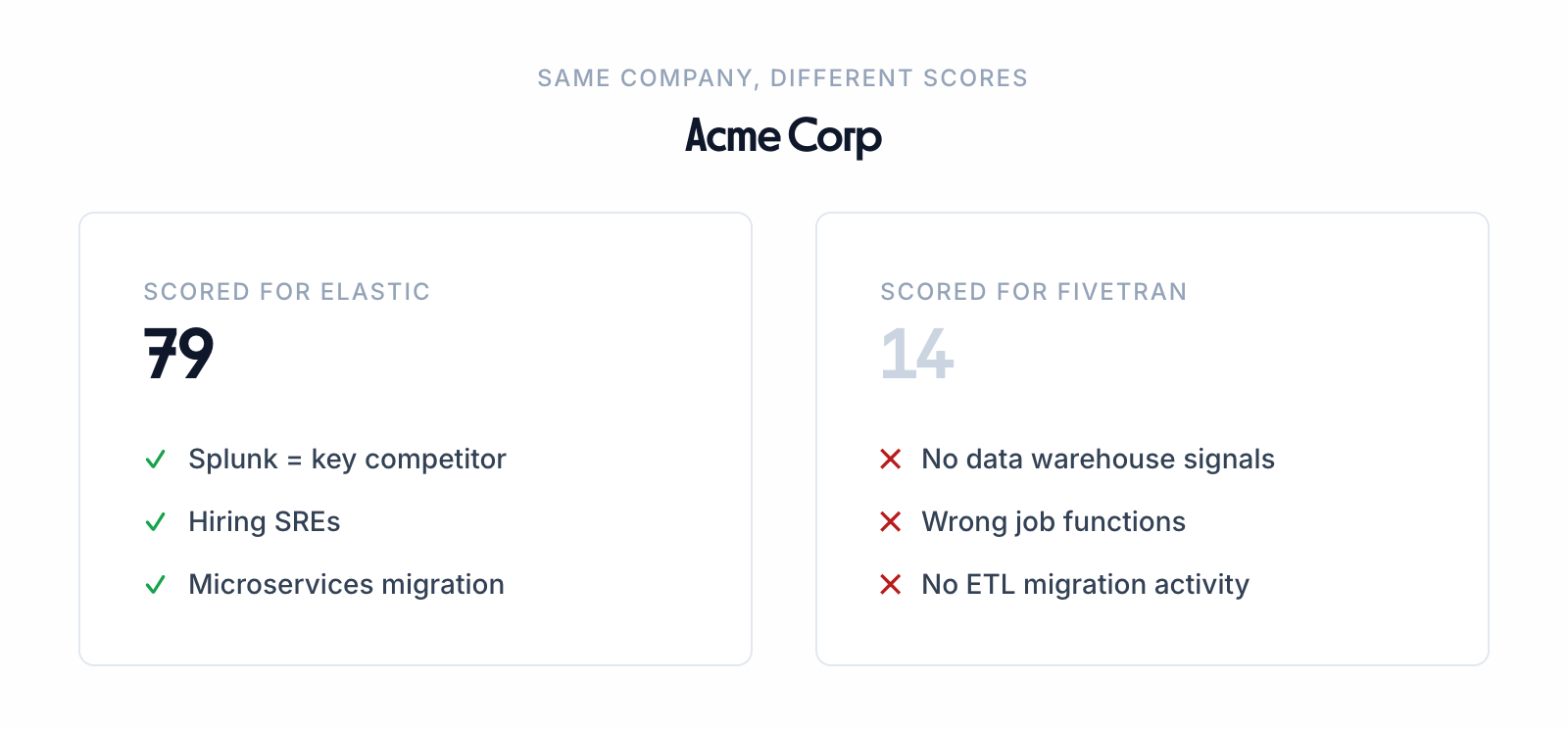
What this means in practice
When your team opens Sumble and sorts by Account Score, they see a list that answers: "Which companies look most like our best deals, right now?"

A mid-market company that just doubled its platform engineering team and is posting cloud migration roles might score higher than a Fortune 500 with a stable (read: not buying anything) IT department. That's the point.
Your scores are yours — built from your ICP, your team's behavior, and the job market patterns that matter to your product. Not a generic model shared across all customers.
And the signals behind them are hard to fake. Job postings are public commitments. When a company posts a role, they've allocated headcount and made a decision to hire. That's a stronger buying signal than a website visit or a content download.
The more your team uses Sumble, the sharper the scores get. Six months in, they're grounded almost entirely in your real search patterns — not what someone put in an ICP doc.
Account scoring is available now for Sumble customers. Talk to your account manager to get your Company Profile configured, or see for yourself at sumble.com.